
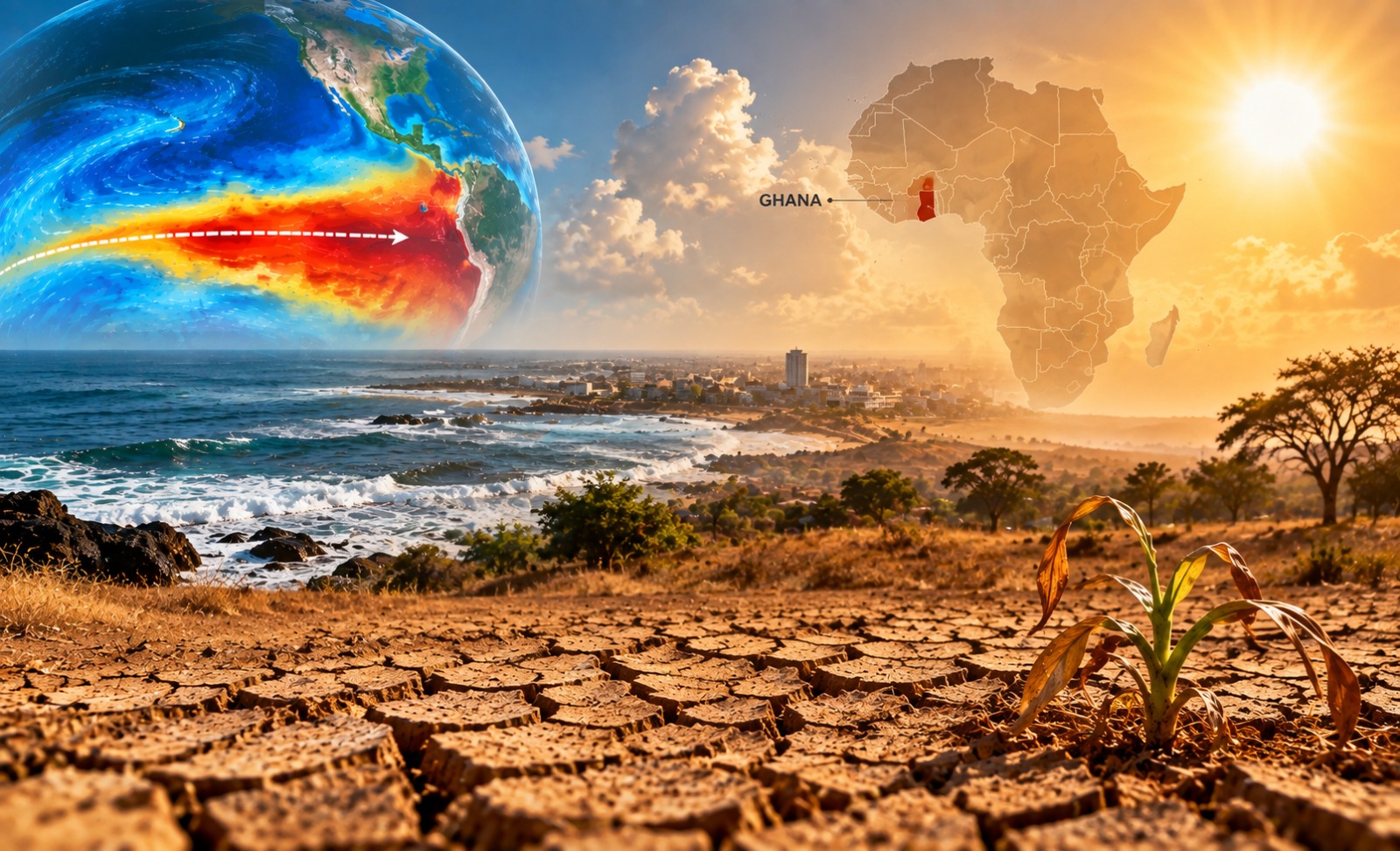
Ghana should prepare for possible rainfall disruptions, longer dry spells and increased heat stress as El Niño strengthens, a climate scientist at the Kwame Nkrumah University of Science and Technology, Kumasi (KNUST) has said.
Dr Jeffrey N. A. Aryee, a senior lecturer in the Department of Meteorology and Climate Science, said the developing conditions could affect agriculture, water supplies, public health and electricity demand, although their impact would vary across the country.
In an analysis of the implications for Ghana, Aryee, who leads KNUST’s Climate Diagnostics, Air Quality & AI (CDAI) Lab, urged authorities to strengthen early preparedness and use local forecasts to guide decisions.
“El Niño is strengthening, but its Ghanaian impacts are not predetermined. Our best defence is to monitor closely, forecast locally and act early,” he wrote.
The World Meteorological Organization (WMO) has forecast further strengthening towards the end of 2026, with a nearly 100% probability that El Niño will persist through February 2027.
In its October 8 bulletin, the Climate Prediction Center of the U.S. National Oceanic and Atmospheric Administration (NOAA) put the probability of a strong to very strong El Niño continuing through January–March 2027 at more than 83%.
El Niño is a naturally occurring climate phenomenon involving unusually warm surface waters in the central and eastern equatorial Pacific. Those changes can alter atmospheric circulation and influence weather thousands of kilometres away.
For Ghana, Aryee said, the central question was “what could it mean for our rainfall, temperatures, agriculture, water resources and livelihoods?”
He cautioned that a strong global event would not necessarily produce equally strong effects in Ghana. The country’s climate also depends on the West African Monsoon, the position and strength of the Inter-Tropical Discontinuity, Atlantic Ocean temperatures and conditions over land.
El Niño should therefore be understood as “a change in the background climate conditions that can shift the probability of particular weather outcomes.”
Research in Ghana illustrates that complexity. A study using 61 years of rainfall data from Ho Municipality found lower annual and major-season rainfall during El Niño years than during La Niña years. However, the El Niño–Southern Oscillation explained only 15% of the variation in annual rainfall.
A separate study of Accra’s rainfall record from 1895 to 2005 found that El Niño’s influence was strongest during the main rains in May and June. Rainfall during the short dry spell and minor rainy season was more closely associated with sea-surface temperatures in the Gulf of Guinea and equatorial Atlantic.
Dr. Aryee said those findings should not be interpreted as a prediction of drought across Ghana.
Depending on how Pacific conditions interact with the Atlantic and the West African Monsoon, some areas could experience reduced rainfall, changes in the timing of rains, longer dry spells or an earlier end to the rainy season.
Such changes could damage crops even where total seasonal rainfall remained close to normal. Rain arriving at the wrong stage of crop development, or prolonged dry spells between rainfall events, could undermine yields.
With much of Ghana’s agriculture dependent on rainfall, Aryee said farmers needed information beyond the question, “Will rainfall be above or below normal?”
“When will the rains start? How well will they be distributed? How long could dry spells last? And when might the rains end?” he wrote.
Heat also required attention. WMO’s September–November 2026 outlook indicated an increased likelihood of above-normal temperatures across almost all land areas.
Dr. Aryee said higher temperatures, combined with reduced rainfall, could increase evaporation, water demand and heat stress, with consequences for people, livestock and crops. Urban areas could face additional pressure because buildings and paved surfaces retain heat.
He also cautioned against allowing concerns about dry conditions to weaken flood preparedness.
A season with below-normal rainfall could still produce individual episodes of intense rain. In Accra, Kumasi and other rapidly urbanising areas, a few hours of heavy rainfall could cause serious flooding regardless of the seasonal total, he said.
Advance monitoring of El Niño offered an opportunity to prepare, Dr. Aryee said. Agricultural agencies could strengthen farmer advisories, while water managers could assess reservoir levels and supply scenarios.
Health authorities could prepare for extreme heat and climate-sensitive diseases, and energy planners could assess potential effects on hydropower generation and electricity demand. Disaster-management agencies should remain ready for both dry conditions and extreme rainfall.
Forecasts from the Ghana Meteorological Agency should guide those decisions, he said. Global outlooks provide the broader picture, but national and local forecasts are needed to assess how conditions may develop within Ghana.
“El Niño is not a forecast of disaster,” Dr. Aryee wrote. “The appropriate response is therefore neither alarm nor complacency. It is preparedness.”


